




To address increasingly complex challenges in mobility, leading companies are investing in data, IoT, and Artificial Intelligence, creating dedicated internal centres of competence. These teams are responsible for transforming data from connected vehicles into practical solutions that improve operations, reduce costs, and enable new business models.
This approach is a key step toward digital transformation. However, technological complexity, lack of historical data, and the absence of dedicated operational structures often make it difficult to achieve a lasting competitive advantage. In this context, an integrated mobility platform like Targa Platform stands out, supporting centres of competence in improving efficiency and reducing costs in a scalable, continuous, and structured way.
In this article:
- The mobility landscape today: challenges and opportunities for companies
- What Centres of Competence are and where Targa Platform can support
- Why choose Targa Platform
- The key strengths of Targa Telematics and its platform
The mobility landscape today: challenges and opportunities for companies
Companies operating in the mobility sector are facing increasing complexity as they strive to deliver personalised customer experiences and high performance. Vehicles are becoming more connected, data volumes are growing rapidly, and operational processes require fast, data-driven decisions.
In this context, IoT and Artificial Intelligence have become essential tools for improving efficiency and enabling new business models. As a result, many organisations have created internal centres of competence to manage data, technologies, and system integrations.
Why does this transformation challenge even the most advanced companies? Because turning data into operational value requires more than technical skills. It demands structured historical data, the ability to integrate multiple sources, domain competences and processes capable of reacting quickly and consistently:
- In the insurance sector, companies increasingly rely on driving behavior and usage data to improve risk assessment and develop usage-based policies. Without a vertical telematics platform, however, this data often remains fragmented, making it difficult to integrate into core processes and limiting the adoption of advanced risk and fraud prevention models.
- In the short- and long-term rental sector, operators must manage large fleets, reduce downtime, and prevent theft or misuse. While connected vehicle data is available, it comes from heterogeneous sources. It is therefore complex and costly to turn it into proactive operational actions without an industrialised automotive IoT platform.
- In corporate fleets, data supports vehicle utilisation optimisation, safety improvements, and decisions related to sustainability and electrification. However, without a unified and historical view, it is difficult to compare performance over time and translate insights into concrete actions.
This scenario shows that even mature companies, rather than struggling with data availability, often lack the ability to integrate, interpret, and activate it within daily operations quickly and at scale.
What Centres of Competence are and where Targa Platform can support
More and more mobility companies are optimising their operations through IoT and Artificial Intelligence by creating internal Centres of Competence dedicated to managing data and digital technologies.
Centres of Competence (CC) are internal teams, mainly composed of IT and data professionals, responsible for developing digital solutions and platforms based on cloud, IoT, and AI. They play a key role in driving digital transformation and represent an important step toward building a data-driven organisation.
However, while these teams bring strong technical capabilities, they often face challenges when it comes to translating vehicle data into scalable and continuous operational value across the business.
When Competence Centres attempt to build a platform using general-purpose cloud technologies, several structural limitations emerge:
- Limited understanding of mobility operational processes
Problem: as primarily technical teams, Competence Centres may lack deep knowledge of core and supporting mobility processes.
Targa Platform’s approach: thanks to its domain expertise, Targa Telematics integrates strong Product Management capabilities that translate operational needs into ready-to-use, validated solutions.
- Challenges in developing complex Mobility IoT & AI platforms
Problem: managing sensor data, time series, and real-time data streams coming from vehicles requires highly specialised skills that are difficult to build and maintain internally.
Targa Platform’s approach: Targa Platform provides a ready-to-use telematics IoT platform designed to manage complex IoT and AI ecosystems, reducing both time and technical complexity.
- General-purpose cloud technologies not tailored to mobility
Problem: standard cloud solutions do not include key mobility concepts such as vehicle lifecycle, configurations, or usage models, requiring heavy customisation.
Targa Platform’s approach: the platform is a vertical mobility platform, natively designed for the industry and enriched with models and logic built and refined over years of real-world use.
- High operational costs
Problem: relying on non-specialised cloud components leads to higher infrastructure and operational costs over time.
Targa Platform’s approach: through a specialised and shared architecture, Targa Platform can reduce operational costs by up to 70%.
- Lack of historical data for AI
Problem: without large, contextualised historical datasets, AI models struggle to deliver meaningful and reliable results.
Targa Platform’s approach: the platform leverages more than 15 years of industry data collected from millions of connected vehicles, improving the effectiveness of AI models.
- Lack of operational structures
Problem: activities such as installations, logistics, and operational fleet management are not typically part of a Competence Centre’s scope.
Targa Platform’s approach: Targa complements its automotive IoT platform with Managed Services that cover all operational activities required to make solutions fully effective. - Difficulty ensuring security and availability
Problem: achieving high standards of cybersecurity, compliance, and system reliability requires significant investment and ongoing effort.
Targa’s approach: the platform embeds security, GDPR compliance, and high availability by design, within a robust integrated mobility platform shared across multiple clients leveraging substantial shared investments that benefit all clients.
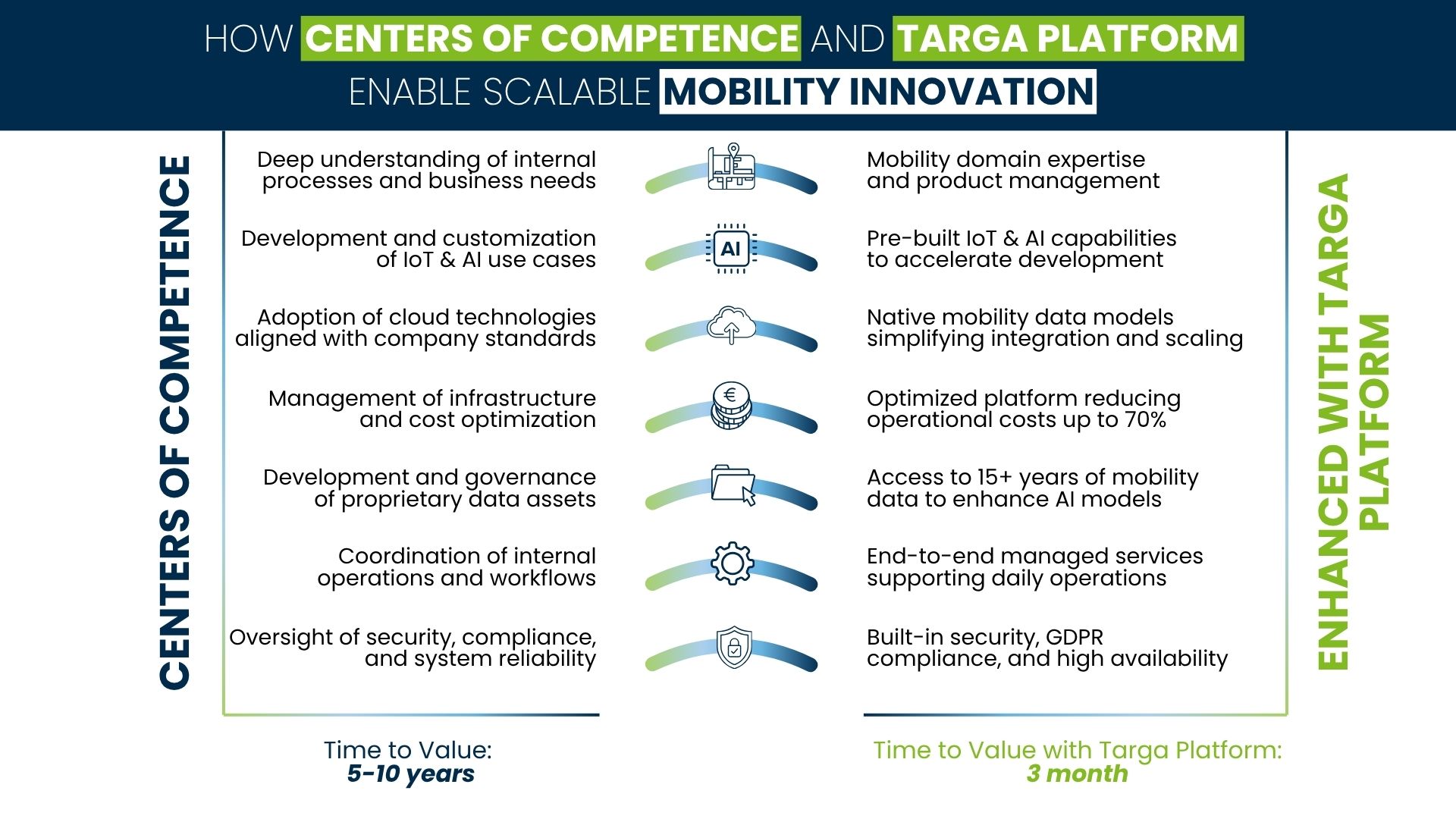
This comparison shows that while Centres of Competence are essential, a vertical smart mobility platform like Targa Platform is key to support them in accelerating IoT and AI deployment and embedding them into daily processes.
Why choose Targa Platform
Targa Platform is an open mobility platform designed specifically for the mobility sector to overcome these limitations. By combining technology, data, and operational services, it enables companies to unlock the value of IoT and AI in approximately 3 months, compared to the 5–10 years required to build a similar solution internally.
This is possible because Targa Platform provides a fully industrialised platform, built on years of industry experience and designed to address real operational needs.
They key strengths of Targa Telematics and its platform
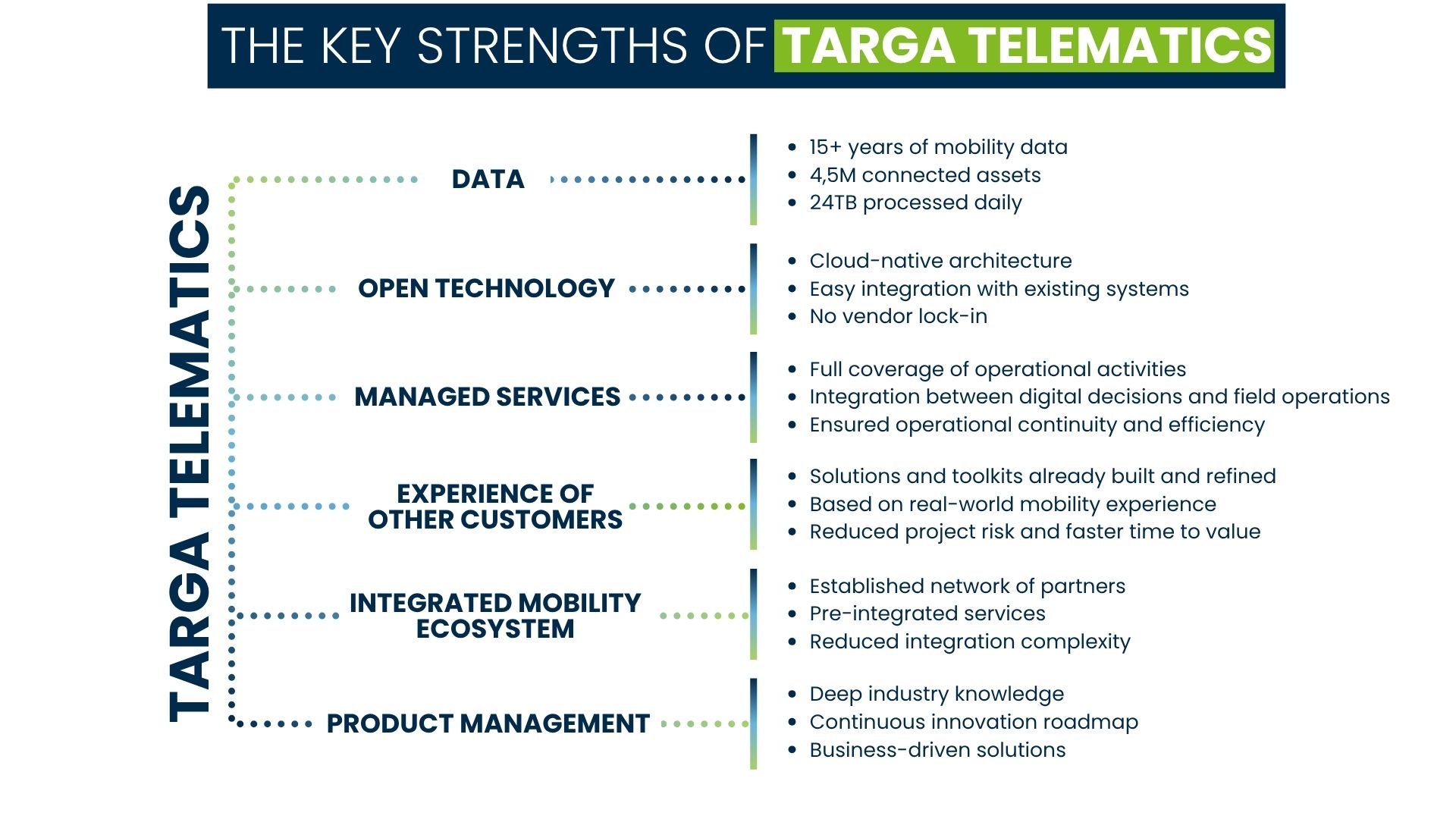
The strength of Targa Telematics and its platform lies in the ability to combine data, technology, and operational services into a single integrated mobility platform, designed to support mobility companies in managing complex processes efficiently and at scale:
Data
One of the main limitations of an internal approach is the lack of sufficient historical data. Even with advanced data science capabilities, starting from scratch means it may take years before reliable datasets are built.
Targa Platform overcomes this with more than 15 years of industry experience, over 5 million connected assets, and approximately 24 terabytes of data processed daily. This allows companies to base decisions on structured, normalised, and representative data.
Open Technology
Building a platform internally requires managing complex cloud architectures, including scalability, security, and compliance.
Targa Platform is a cloud-native and open IoT platform for automotive. “Open” means technological freedom: companies are not locked into a closed ecosystem and can integrate the platform with existing systems or adopt only the modules they need.
Its modular architecture supports gradual evolution, avoiding duplication and enabling seamless integration with internal solutions. Security, GDPR compliance, and infrastructure robustness are built in from the start.
Managed Services
Centres of Competence typically focus on technology development and lack operational structures. Activities such as installations, logistics, fleet operations, and ongoing support must be managed separately, increasing complexity.
Targa Telematics complements its telematics platform with comprehensive Managed Services, ensuring continuity, efficiency, and alignment between digital decisions and real-world operations.
Experience of other customers
Internal development often involves long testing cycles and high uncertainty. Targa Platform integrates solutions already validated across real mobility use cases, such as downtime management, fraud prevention, and stolen vehicle recovery.
This reduces project risk and accelerates adoption.
Partner ecosystem
Building a platform internally also means managing multiple integrations with external providers.
Targa Platform operates within a well-established ecosystem of partners, simplifying integration and accelerating deployment for companies adopting a shared mobility management solution platform.
Product Management
A key differentiator of Targa Platform is its deep domain expertise. Targa Telematics understands the needs of rental companies, insurers, and fleet operators, including their processes and business logic.
This expertise is reflected in a strong Product Management function that connects technology, business, clients, and partners. Product Managers combine consulting skills, domain knowledge, and technical expertise to guide a continuously evolving roadmap aligned with market needs.
Ongoing collaboration with customers and partners ensures alignment with emerging challenges in digitalisation and service innovation. Each team also allocates around 20% of its budget to innovation initiatives, supporting long-term differentiation.
In this way, Targa Telematics supports, rather than replacing, Centres of Competence, providing domain expertise that helps transform data into solutions aligned with real operational processes.
In a context where data, IoT, and Artificial Intelligence are becoming increasingly central, the true differentiator is not just data availability, but the ability to integrate and activate it within business processes.
Targa Platform is designed to meet this need, helping mobility companies transform technological complexity into tangible value in a fast, scalable, and sustainable way.
At the same time, its open and modular architecture enables seamless integration with existing customer and their partner infrastructures, allowing companies to enhance their current technology landscape without disruption and evolve it progressively over time.
