



For months now, petrol and diesel prices have been exceptionally high, whilst electricity tariffs continue to fluctuate in these uncertain times. For businesses, this translates into higher operational costs for their vehicle fleets. But the real problem lies elsewhere. Although, as a fleet manager, you have no control over energy prices, a large proportion of the other costs can still be managed. Unfortunately, these are usually not clearly visible, poorly measured and rarely actively managed.
In Belgium, the price of petrol has risen by around 10 per cent over the past two years. For diesel, a visit to the petrol station has become 15 to 20 per cent more expensive. Electricity prices have also followed an upward trend, although this is perhaps slightly less pronounced.
Let’s take a hypothetical example to illustrate the impact of this. Suppose a company has a fleet of 100 ICE vehicles, each covering around 25,000 km per year, with an average fuel consumption of 6.5 l/100 km. For the organisation, this amounts to a total consumption of 162,500 litres. If we assume that the fuel price has risen by €0.23 per litre over two years, this results in an additional annual cost of over €37,000.
In this scenario, vehicles are used in the same way as before. The only difference is the rise in fuel prices, resulting in a huge additional cost. This shows that companies have no control over developments in the energy market. Yet they do indeed have tools at their disposal to keep the costs of their fleet usage under control: driving behaviour, charging habits, usage patterns and route optimisation are currently rarely measured and seldom managed proactively. But it is precisely these factors that help to offset some of the rising energy costs and bring them back under control.
The true costs of your fleet go beyond energy prices
Although we cannot predict exactly how fuel and electricity prices will evolve over the coming months, organisations still have the power to control a large proportion of their fleet expenditure. Rather than simply monitoring expenditure, companies need to be able to understand precisely where costs are coming from. And that’s only possible if you also look at the day-to-day use of your vehicles.
The total cost of ownership (TCO) of a vehicle is, of course, more than just the purchase price. The actual use of the vehicle is decisive. Driving behaviour, chosen routes, the frequency of stops and habits regarding refuelling or charging all have a direct impact on operational costs. Unfortunately, these aspects often remain hidden from fleet managers.
This is even more evident with electric vehicles. Consistently using fast-charging systems instead of charging at home or at work can lead to significant cost differences. A dynamic driving style or poorly planned journeys can also increase energy consumption. Consequently, even two identical electric vehicles will have different operating costs, simply because they are used differently on a daily basis.
From gut feeling to data-driven decisions
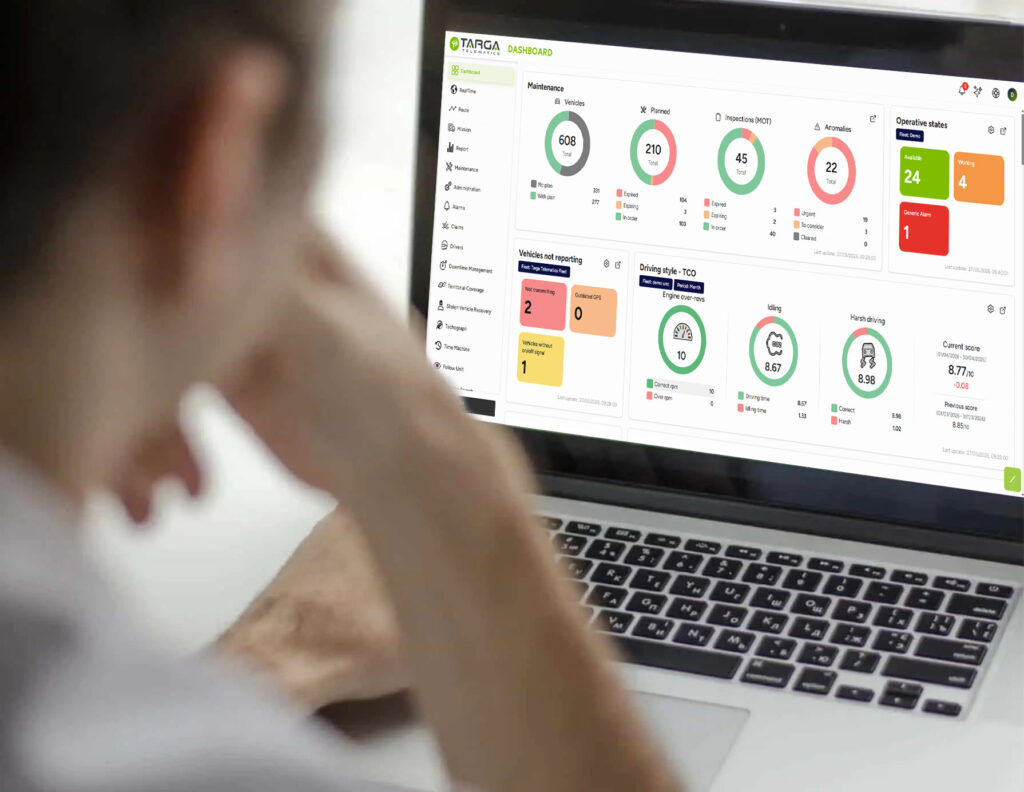
In the current climate, it is no longer enough to rely solely on experience or intuition. Telematics solutions take you a step further. They enable organisations to collect vehicle data from various sources and analyse it automatically, with the aim of identifying anomalies, inefficiencies or opportunities for optimisation. Raw data is thus converted into practical recommendations that fleet managers can implement immediately.
For example, it becomes possible to detect repeated use of fast-charging points, or to identify that a vehicle is following inefficient routes. Energy-intensive driving behaviour is also revealed through the data. The advantage of this level of information is that the organisation can take targeted action by raising awareness amongst drivers, adjusting internal policies, improving charging strategies or reviewing the way in which vehicles are allocated. Data thus provides a tool for decision-making. Organisations not only understand where their costs come from, but also how to control and reduce them.
We can even use telematics to guide the choice of vehicle. With the help of data, fleet managers can assess the potential of electric driving. Someone who drives short distances every day is the ideal candidate for an electric car. Those who spend a lot of time on the road or have limited access to charging infrastructure may, for the time being, still benefit more from a fuel-efficient petrol car.
Not all company cars are equally suitable for electrification at present, but data will show that a large proportion are indeed eligible without this having any impact on day-to-day operations. Given that price rises for fuel are often greater than those for electricity, there are certainly gains to be made here for business fleets. Moreover, telematics data will sometimes reveal that vehicles are idle too often, whilst still incurring fixed costs. These are all insights that significantly influence fleet expenditure.
In practice, data helps to highlight situations that would otherwise go unnoticed: underutilised vehicles, frequent use of expensive charging points, excessively long periods of inactivity or non-optimised routes. Taken individually, these inefficiencies may not seem to amount to much. But across an entire fleet, they represent thousands of euros in avoidable expenditure every year.
Up to 25% reduction in energy costs
In an uncertain world characterised by volatile energy prices, any form of inefficiency has a significant financial impact. Efficient organisations therefore do more than simply map out their costs. They use data to understand, anticipate and act. Sector studies show that fleets equipped with telematics can reduce their fuel and energy costs by 20 to 25 per cent. This therefore presents a concrete opportunity to significantly improve the fleet’s profitability, even in these volatile times.
In a climate where businesses have no control over fluctuations in fuel or electricity prices, data is one of the few levers they can utilise immediately. If organisations are able to translate data into operational decisions, they are not only better equipped to absorb price rises, but also to improve the long-term performance and profitability of their fleet.
