



From January 1, 2027, Belgian organizations with more than 50 employees will be required to offer the mobility budget. One year later, the obligation will extend to companies with at least 15 employees. Yet even before these regulations take effect, many organizations are already exploring how to implement a mobility budget.
In doing so, one critical question is often overlooked: what should the mobility budget actually be based on? Without a detailed understanding of fleet usage, employee mobility patterns, and the associated costs, there is a significant risk of designing a policy that looks good on paper but fails to reflect reality.
Fortunately, connected data and telematics can provide the insights organizations need to make a successful transition to the mobility budget. By understanding how employees travel today and how vehicles are used, companies can build a data-driven mobility strategy and empower their workforce to make informed mobility choices.

1. Do you really know how your fleet is used?
Even before defining a mobility budget policy, it is essential to understand how vehicles are used on a day-to-day basis. In many companies, decisions are still based on assumptions, historical rules or averages. Yet the operational reality is often different: some vehicles are driven very little, others are in high demand, and some journeys could be avoided or shared.
This raises another question: is your fleet sized to meet your actual needs? Do you have the right number of vehicles, and are staff using the right ones?
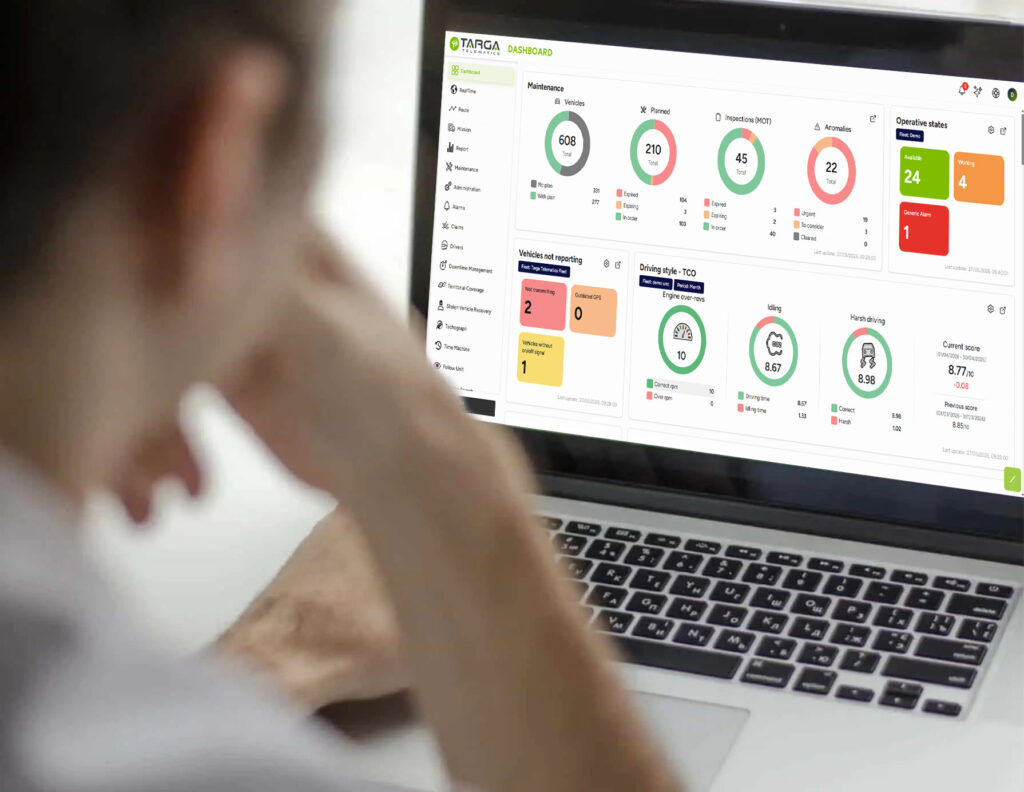
Telematics enables an objective analysis of this usage: journeys, frequency, timings, the split between business and private use, utilisation rates and even peaks in usage. This approach allows you to move from a theoretical view to a concrete understanding of mobility needs. The mobility budget is then no longer simply a matter of replacing a car with a cash allowance, but of rethinking the entire mobility model.
2. How can you make your fleet more sustainable?
The transition to more sustainable mobility is at the heart of the mobility budget. But it cannot be defined in a one-size-fits-all manner. Not all uses are equal: some journeys lend themselves to alternatives (cycling, public transport, car-sharing), whilst others still require a private car, whether petrol-powered or electric.
Analysing usage data enables you to pinpoint the most relevant segments for transformation: short, regular journeys, urban travel, under-utilised vehicles, etc. It also allows for a concrete assessment of the fleet’s electrification potential, as well as the associated CO₂ savings and financial impacts. The transition then becomes measurable, gradual and aligned with operational reality.
3. Do you have a complete overview of your mobility costs?
The mobility budget hinges on one key factor: the actual cost of the company car, the TCO (Total Cost of Ownership). However, this cost is often poorly managed, as it depends on numerous variables: fuel or energy, maintenance, leasing, downtime, driving behaviour, etc.
Telematics enables us to go far beyond a theoretical estimate, using real-world usage data to analyse costs in detail and identify inefficiencies. The result: a better-calibrated mobility budget that is credible for both the company and its staff, and capable of generating tangible savings.
4. Do you support your employees in their mobility choices?
Whilst companies are required to offer a mobility budget, employees remain free to accept it or not. For some, keeping their current company car remains the most practical option, particularly in the case of frequent long journeys. For others, a smaller vehicle or alternatives such as cycling or public transport may be more advantageous. In some cases, part of the allowance can even be used to cover rent or a mortgage, if the employee lives close to their place of work.
The choice depends on many factors. However, most employees base their decision on assumptions rather than on actual data. Thanks to telematics, employers can provide personalised, evidence-based recommendations, enabling everyone to understand the impact of the various options and make the choice best suited to their situation.
5. Are you able to manage your mobility in the long term?
Setting up a mobility budget is not a one-off decision, but an ongoing transformation. Once the policy is in place, the challenge becomes management: monitoring usage, measuring impacts, adjusting measures and demonstrating results.
Here too, data plays a key role. Connected solutions enable real-time monitoring, the measurement of the impacts of decisions taken, and the production of the necessary reports (mileage, business/private use, remote working, etc.). The mobility budget thus evolves from a simple administrative measure into a genuine strategic management tool.
From compliance to performance
The mobility budget is often viewed through the lens of regulatory compliance or employee benefits. But its true value goes far beyond that. Corporate mobility is no longer limited to fleet management: it is becoming a comprehensive system and a strategic lever for both employers and employees.
In this context, telematics is emerging as a key element: it enables a shift from intuition to informed decision-making. Without usage data, it is difficult to make the right choices. With a telematics-based approach, the mobility budget becomes more relevant, measurable, adaptable and sustainable over time.
